
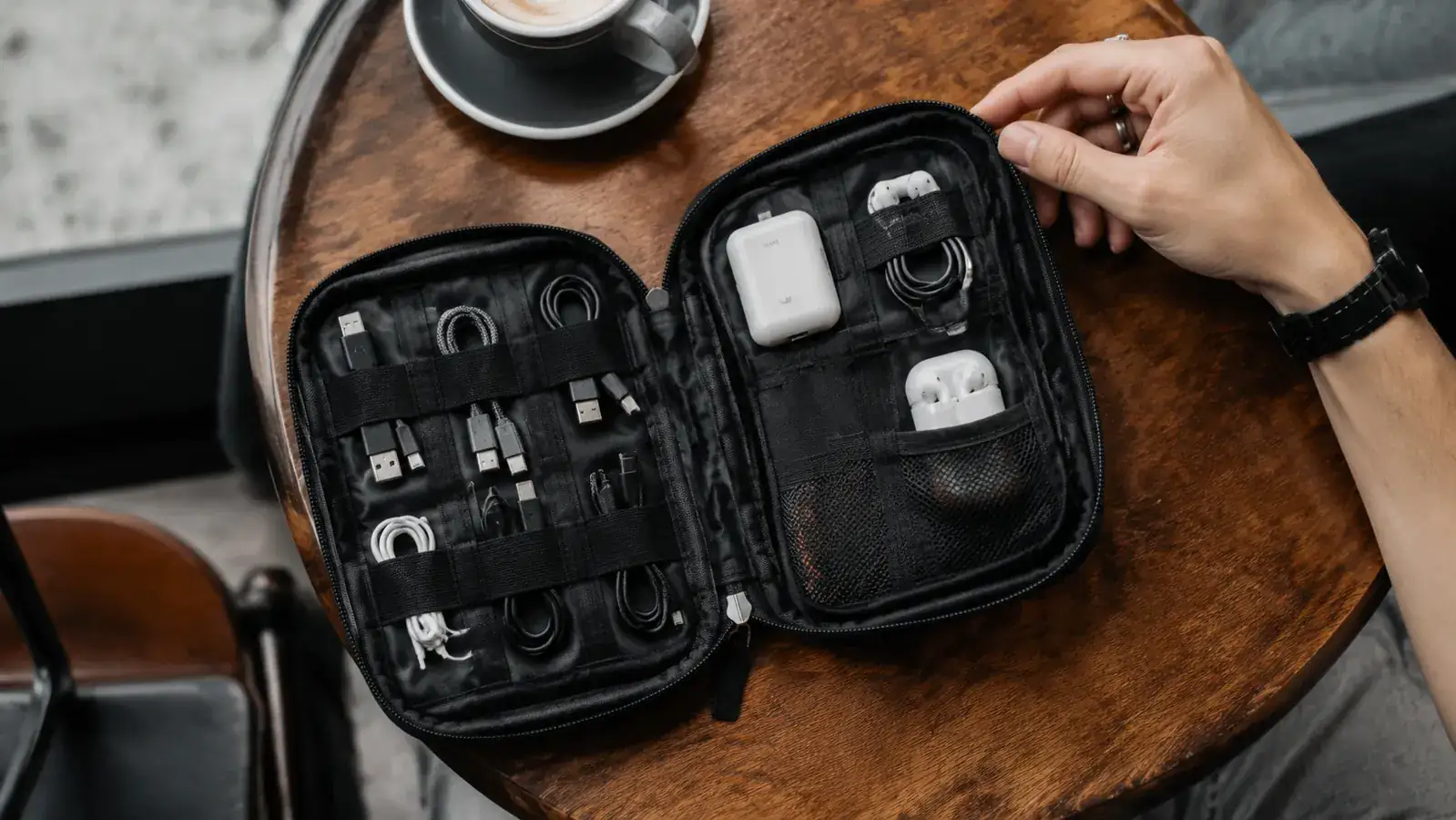
Here is something I almost never see in gear reviews: the part where the reviewer admits what broke first. I bought the FYY Travel Cable Organizer Pouch about thirteen months ago, right before a six-week trip through Southeast Asia. I have used it on every flight since, which adds up to roughly 34 trips and, conservatively, 300 times opening and closing those zippers. I know exactly what held up and exactly what did not. The 38,000 people who rated this thing mostly reviewed it after a week or a month. I am here to tell you what happens at twelve months of genuine daily carry.
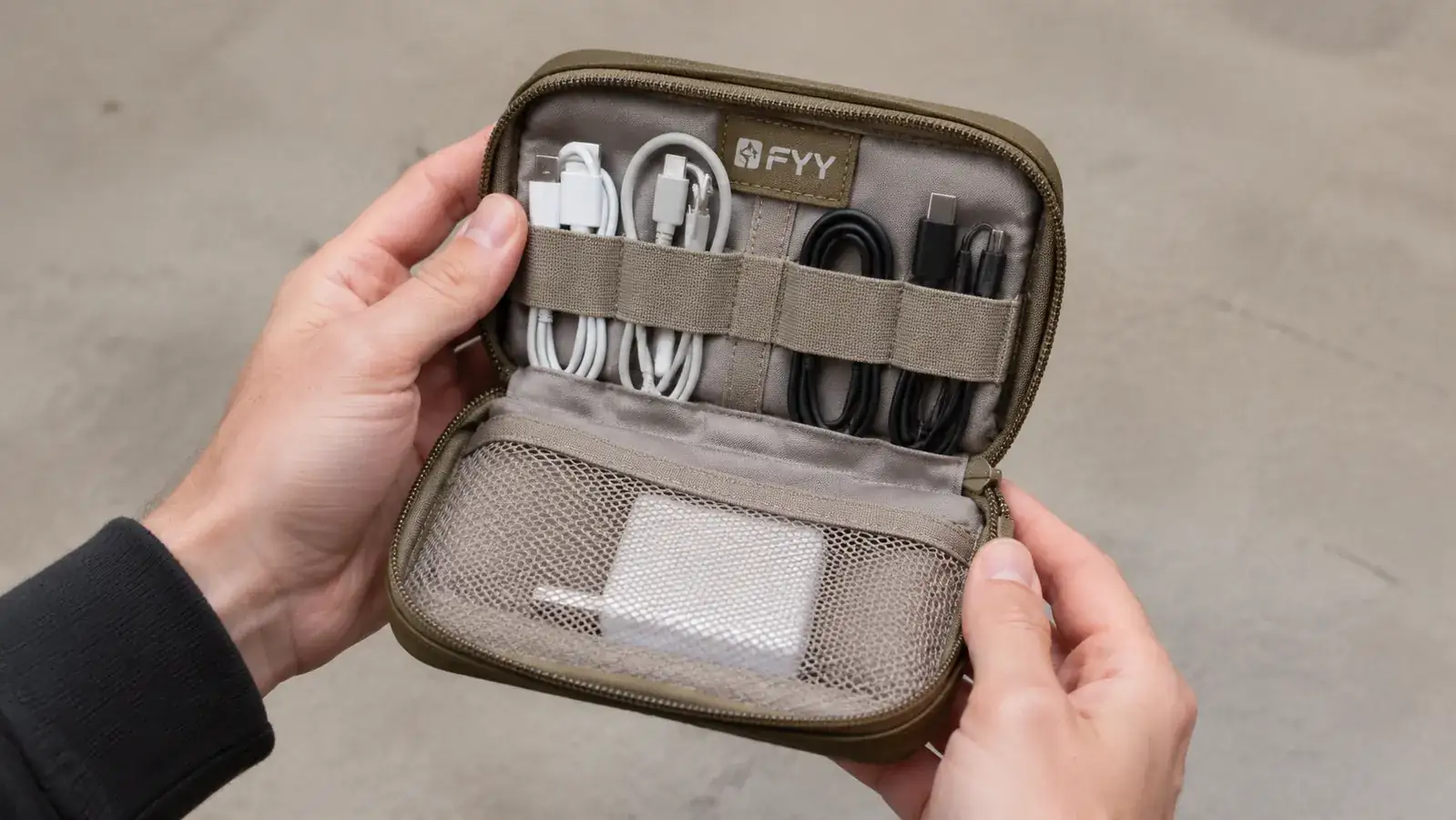
The FYY cable pouch is a double-layer soft organizer made from what FYY calls waterproof nylon. It holds cables, small adapters, earbuds, and similar accessories in a pocketed interior with elastic loops on one panel and a zippered mesh pocket on the other. It retails at the budget end, fits in the front pocket of most personal item bags, and has the kind of rating count that makes you wonder if the reviews can all possibly be honest. Before I get into the durability findings, the short answer on whether to buy it: yes, with one significant asterisk I will explain in detail below.
The Quick Verdict
Excellent organization for the price, with one real durability concern at the 8-month mark that most buyers will not encounter if they pack it correctly.
Amazon Check Today's Price →Still coiling cables in a ziplock? This is the fix that costs less than lunch.
The FYY cable organizer is the most-rated travel electronics pouch in its category. Check today's price and availability on Amazon before deciding.
Amazon Check Today's Price on Amazon →What I Actually Carry in It (And How Much Fits)
Let me be specific, because capacity claims on Amazon photos always show the lightest possible load. My daily cable kit for work travel includes: one USB-C to USB-C cable (1 meter, braided), one USB-C to Lightning cable, one USB-A to USB-C cable, one 65W GaN brick (roughly 55mm x 55mm x 30mm), one set of wired earbuds, one small multi-port USB hub, and two SD cards in a slim hard case. That is a full carry for a typical digital traveler.
The FYY fits all of that, but only barely. The 65W GaN brick occupies most of the bottom main compartment. The three cables coil into the elastic loops in the top panel. The earbuds tuck into the small mesh pocket. The SD card case lays flat on top of the brick and makes closing the outer zipper tight enough that I have to pull with two hands on the first few attempts until the nylon relaxes slightly. If your charger is a larger 90W or 100W brick, it will not close without visible distortion. If you are still using an older Apple 20W cube or a flat USB-A wall plug, you have room to spare and the pouch will feel half-empty. This is worth knowing before you order, because the Amazon photos show a 20W cube and four thin cables and call it full.
The Zipper Test: What the Reviews Skip
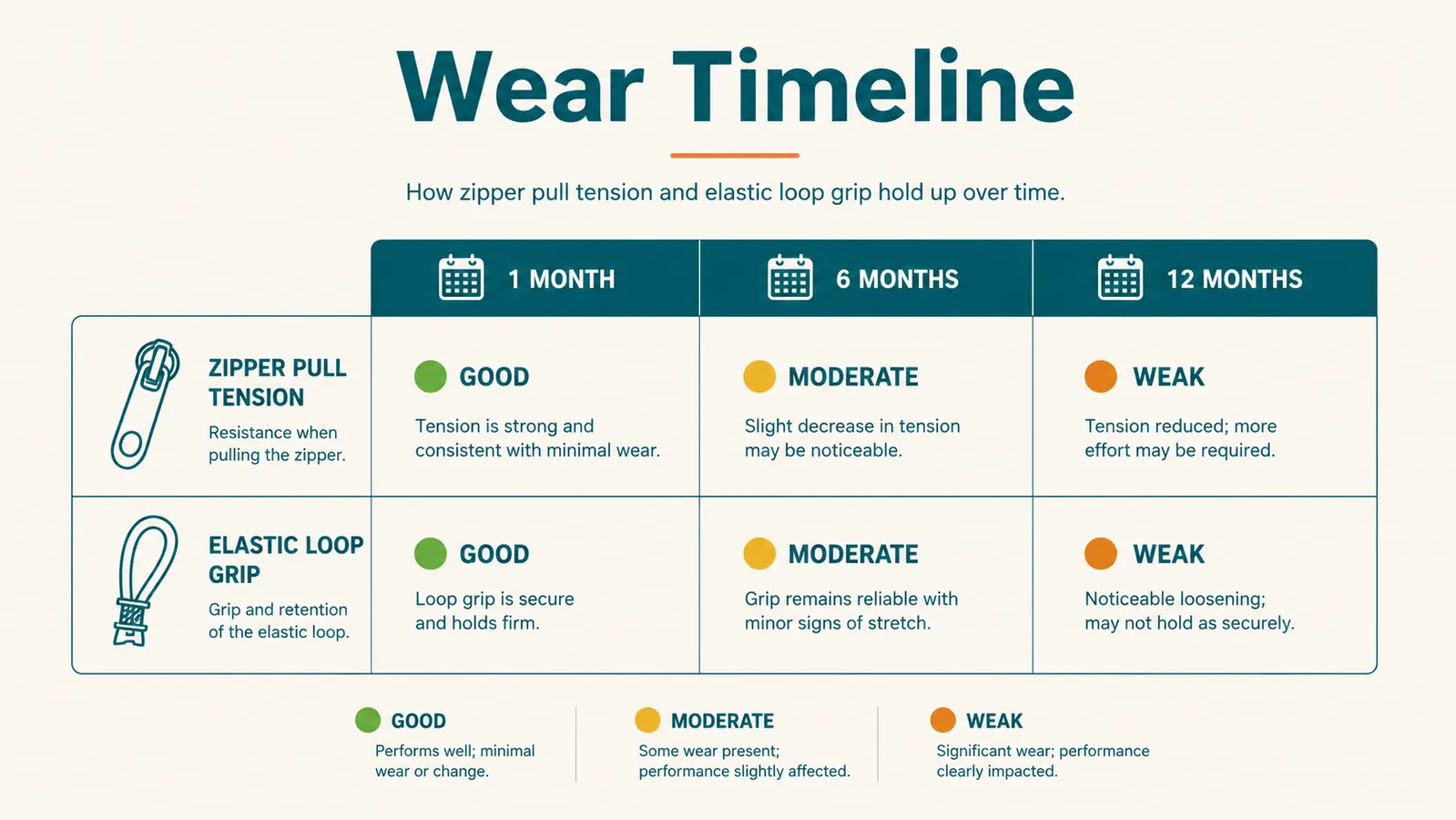
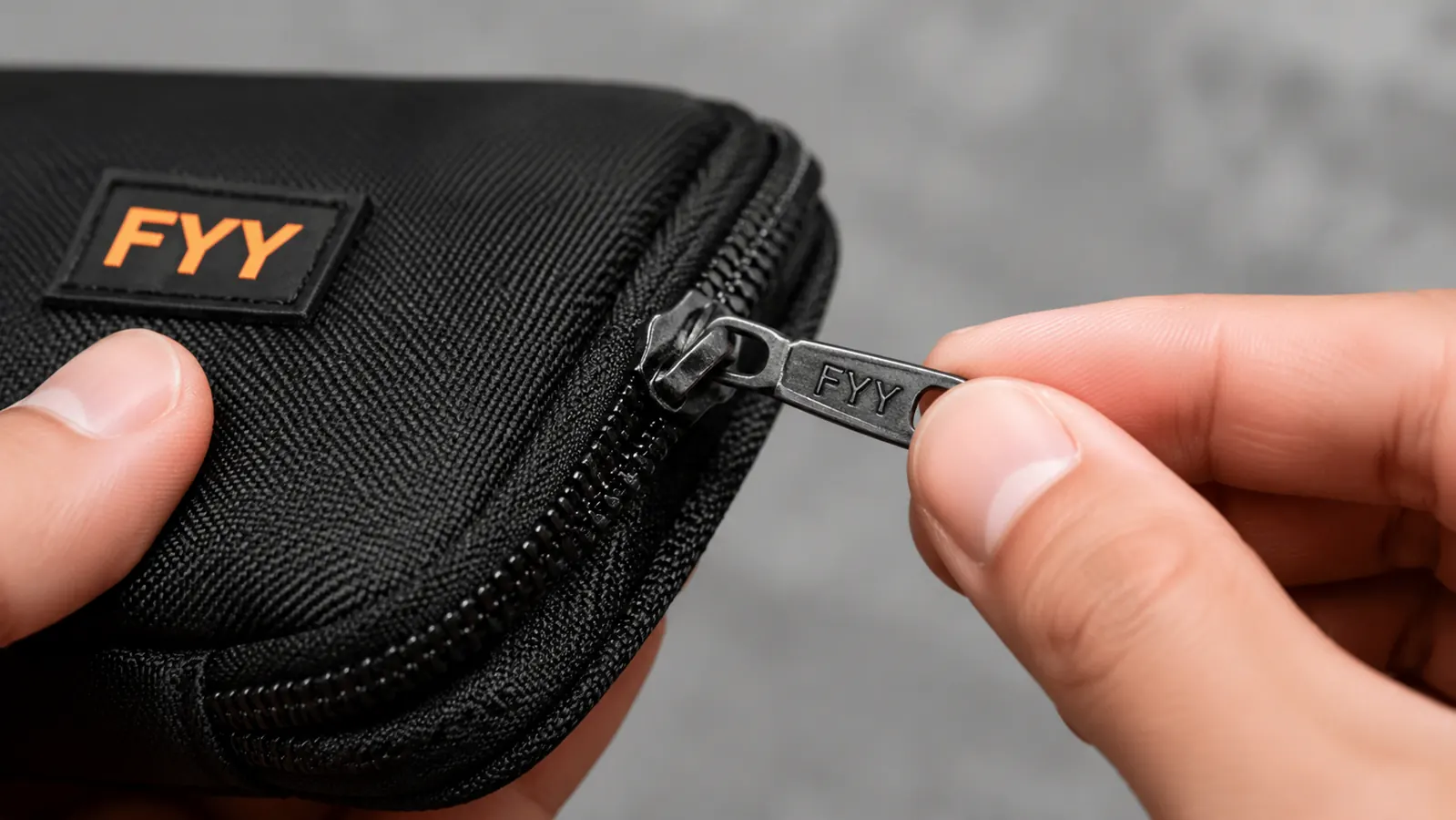
The FYY pouch uses two separate zippers: a large U-shaped zipper for the main compartment and a smaller zipper across the top panel. At month one, both ran smooth with one hand and required no deliberate attention. By month four, the main zipper needed a slightly firmer pull at one corner of the U-shape, which is the point where the zipper track bends sharpest when the pouch is full. That is a stress point on almost any bag zipper, and it is where wear accumulates first. By month six, the resistance at that corner was noticeable but not problematic. At month eight, I noticed that the fabric pull tab on the main zipper had started to fray where I grip it.
Here is what matters about that fraying: it happened because I grip the same exact spot every single time I open the pouch. I am right-handed, I hold the pouch with my left hand, and I pull the zipper with my right thumb and forefinger at the bottom of the pull tab. That corner received several hundred focused stress applications. If you are the kind of person who grabs wherever is convenient, the wear distributes across the whole tab and you will likely see no fraying at twelve months. My fix, which I should have done from the start: thread a small split ring or key ring through the zipper pull hole. It gives you a larger grip surface, distributes the pull force, and costs nothing. The zipper teeth themselves on both tracks are in perfect condition at thirteen months. The mechanism is not the weak point. The fabric is.
The Elastic Band Stretch Problem Nobody Warns You About
This is the finding that surprised me most, because it is not something you read in any of the 38,000 reviews. The interior top panel has six elastic loops arranged in two rows of three. They are designed to hold individual cables flat and separated so nothing tangles. At month one, the loops gripped a coiled USB-C cable firmly enough that I had to pull with intention to remove it. By month four, two of the most-used loops had noticeably softer tension. By month seven, those two loops would hold a flat-folded cable but would not reliably hold a coiled cable with any memory in the wire. By month ten, both of the loops I used most frequently were essentially decorative.
The four loops I used less frequently were still functional at thirteen months. This tells me the elastics are not inherently low-quality. They degrade under repeated stretch cycles in a predictable pattern: high-use loops fail first. The practical fix is to change how you pack the cables. Cables that are accordion-folded flat and slid into a loose loop stay put. Cables that are coiled with tension fight the loop and accelerate wear. I now fold every cable before storing it and the system works fine. It is a small technique shift but it extends the useful life of the elastic panel from roughly seven months to well beyond a year. If you are not willing to adjust your packing technique, budget for a replacement pouch around the one-year mark.
The zipper teeth at thirteen months are perfect. It is the fabric pull tab that frays first, and that is a five-cent fix if you add a key ring before the wear starts.
The Waterproof Claim: What It Actually Means
FYY describes the material as waterproof nylon, and I tested this claim twice. The first time was accidental: my water bottle leaked inside my bag on a bus in Hanoi and the pouch sat in a small pool of water for about twenty minutes. When I opened the bag, the exterior of the pouch was wet and the interior was completely dry. Every cable, every adapter, fine. The nylon fabric itself genuinely repels water. Surface moisture beads off rather than soaking through, which is better performance than I expected from a sub-ten-dollar organizer.
The second test was also accidental, but less favorable. I packed the pouch at the bottom of my personal item after a beach day in Bali, under a wet swimsuit and a damp towel. After about forty minutes in a closed hot bag, there was noticeable moisture inside the pouch. Water entered through the zipper tracks, not through the fabric. So the honest summary is this: the fabric passes the splash test and the brief-immersion test. It does not pass the sustained wet-environment test. If you are worried about electronics getting wet, the FYY keeps your cables safe from spills and light rain. It will not protect them from a soaked bag over an extended period. Pack accordingly, and if you need true waterproofing, look at pouches with sealed zipper tracks.

The One Scenario Where It Quietly Fails
The FYY pouch is designed for cables and small accessories and it excels within that scope. Where it fails quietly is when travelers try to use it as a general electronics catchall. On a flight from Singapore to Sydney last October, I watched a seatmate try to wedge a full-size over-ear headphone case, a Kindle, a 100W laptop charger, and four cables into one FYY pouch. She got it closed, but the pouch was so distorted it would not lay flat, and she had to unpack everything to find a single cable buried at the bottom. The pouch became a black hole rather than an organizer.
The pouch is designed for accessories that support your devices, not for the devices themselves. Cables, adapters, earbuds, SD cards, a small USB hub: these belong in the FYY. A Kindle, a set of large over-ear headphones, a power bank larger than 10,000 mAh: you are asking the pouch to be something it was never built to be. If you have a large electronics kit, consider buying two FYY pouches and assigning each a category. Cables and adapters in one, earbuds and card readers in the other. At budget pricing, a two-pouch system costs less than a single hard-shell tech case and gives you faster access to everything because neither pouch is overpacked.
How It Compares to the Alternatives You Are Probably Considering
Before the FYY, I used a quart-size ziplock bag for cables on every trip. I want to be honest about that comparison because some travelers will wonder if a dedicated organizer is actually necessary. The ziplock holds the same volume and costs essentially nothing. But the cable tangle problem in a ziplock is real and worsens with every trip. A coiled USB-C cable wrapped around an earbud cord is frustrating to untangle in a dark plane cabin at 2 a.m. when the person next to you is asleep. The FYY's elastic loops, even when slightly stretched at the one-year mark, keep each cable in a designated spot. The time I save finding a specific cable is small per trip but adds up over dozens of trips. The tactile experience of opening an organized pouch rather than rooting through a crinkled plastic bag is simply better, and that matters when you are tired.
Compared to a hard-shell tech case, the FYY is more compact but offers less protection for items that can crack or scratch. If you travel with a portable hard drive, a fragile multi-port hub, or an expensive set of adapters, a hard-shell case with rigid interior trays is the right choice. If you are carrying cables, earbuds, and soft adapters that do not need protection from impacts, the soft pouch is a better packer because it conforms to the shape of whatever space is available in your bag. A rigid case is a fixed volume. The FYY compresses to fit.
What We Liked
- Genuinely compact and fits in a front-pocket slot that most personal item bags have
- Double-layer design keeps cables separated from earbuds and small accessories so nothing tangles
- Fabric is water-resistant enough to survive a bag spill or light rain without soaking cables
- Budget-friendly makes it easy to buy two for a cleaner two-category system
- Available in multiple colors, which helps distinguish a cable pouch from a toiletry pouch in a dark bag at the bottom of your carry-on
Where It Falls Short
- Elastic loops lose meaningful tension around month five with heavy daily use if cables are stored coiled
- One zipper pull tab began fraying at month eight under repetitive single-point gripping
- Capacity becomes tight with modern GaN charger bricks over 65W in real-world packing
- Zipper tracks are not waterproof and will allow moisture into the pouch in a sustained wet environment
- No internal divider in the main compartment means a full load of gear compresses into a single flat mass
Who This Is For
The FYY cable organizer is the right buy if you travel frequently and want a reliable, low-cost way to keep your charging accessories together and findable without adding bulk to your bag. It works best for travelers whose kit centers on USB-C cables, compact charger bricks under 65W, and wired or wireless earbuds. If your packing list includes a laptop, phone, earbuds, and a small adapter, this pouch holds all of it with room for a few extras. The price point makes it easy to commit to two pouches without overthinking the purchase. That two-pouch system, one for cables and chargers and one for earbuds and adapters, costs in the budget range combined and beats any single higher-priced organizer for pure access speed. It is also a strong choice for frequent flyers who want to replace their pouch annually and not feel guilty about it, because at this price point, yearly replacement is not a problem.
Who Should Skip It
Pass on this pouch if your primary travel charger is a large 100W or 140W brick. It will technically close around one, but the capacity strain accelerates zipper corner wear faster than my timeline above. Also skip it if you need true waterproof protection for a fragile or expensive accessory like a backup hard drive or a camera adapter worth more than the pouch itself. For those items, invest in a hard-shell case with a known IP rating and sealed zippers. And if you are the kind of traveler who buys gear expecting it to last five or more years with zero maintenance attention, the elastic loops will frustrate you before you hit the two-year mark. This is a value buy that performs very well within its limitations. It is not a lifetime piece of kit, and it does not pretend to be. At this price point, that is exactly the right trade.
After 34 trips, I still reach for it every time I pack. Here is today's price.
The FYY cable organizer remains my daily carry pouch after thirteen months of honest use. At current pricing it is one of the easiest travel purchases you can make. See availability and the current price on Amazon.
Amazon Check Today's Price on Amazon →