
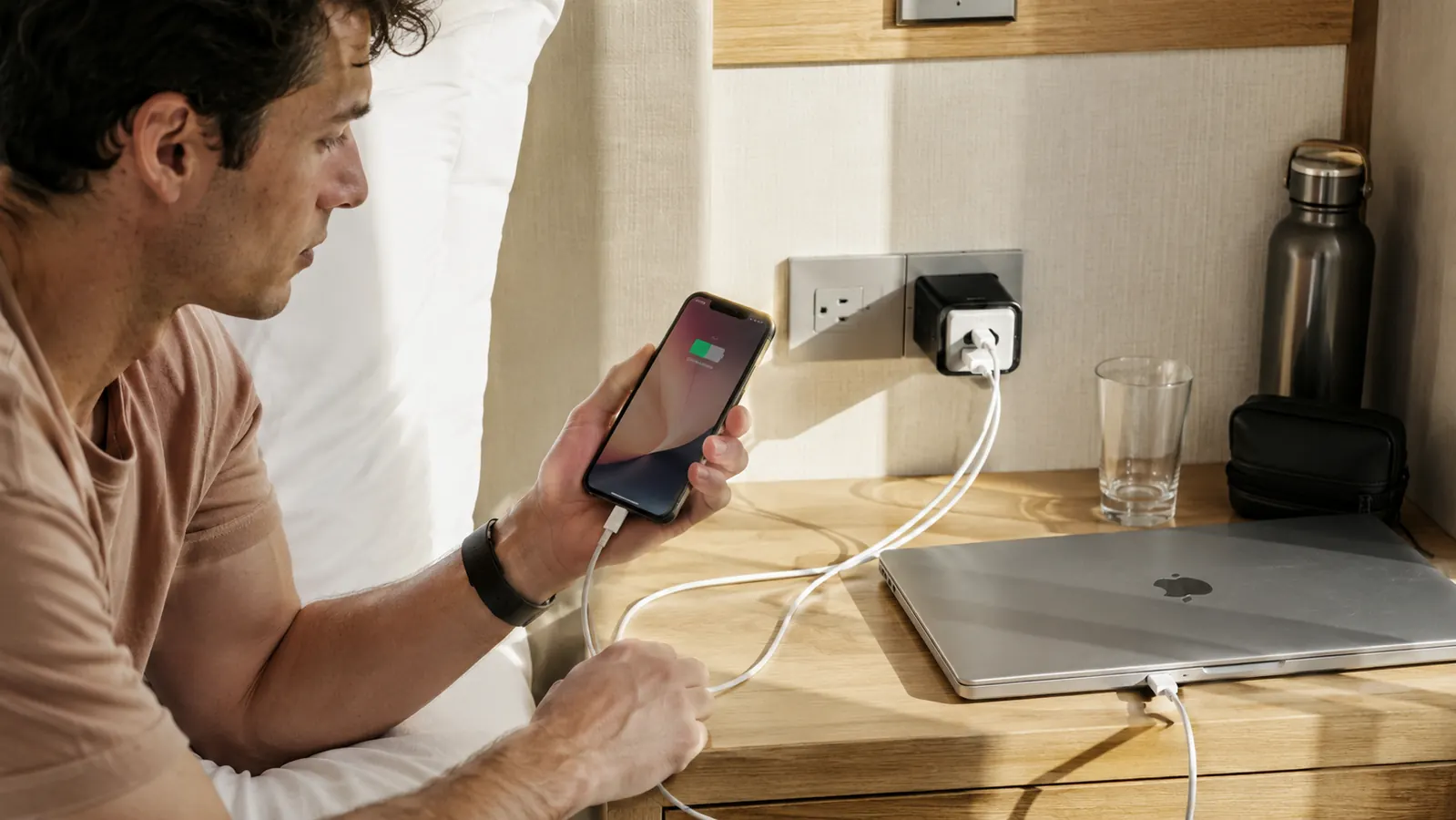
Here is the short answer if you are in a hurry: if you are traveling with a modern laptop, phone, tablet, camera, or USB-C device, you almost certainly need a travel adapter, not a voltage converter. Buy the adapter, pack light, and move on. But if you are packing a 1,500-watt hair dryer from the US and you cannot live without it in Europe, you need a converter, and you need to read the rest of this before you plug it in.
I have seen both types of travelers at airport hotels: the one who thought an adapter converts voltage (it does not) and torched their straightener at 3am, and the one who bought an expensive converter they never actually needed because their phone charger already handles 100-240V. Both mistakes are avoidable if you understand what each device actually does. The VYLEE 5-in-1 universal travel adapter is the one I carry and recommend for most people. A voltage converter serves a much smaller, specific audience. This comparison will show you exactly who falls into which camp.
| Travel Adapter | Voltage Converter | |
|---|---|---|
| What it does | Changes plug shape only so your device fits a foreign outlet | Changes the outlet voltage (e.g., 220V to 110V) so single-voltage devices can run safely |
| What it does NOT do | Does not change voltage at all | Does not add USB ports or multi-country plug types on its own |
| Compatible devices | Any dual-voltage device (laptops, phones, tablets, cameras, most modern chargers labeled 100-240V) | Single-voltage appliances only (older US hair dryers, some curling irons, vintage electronics rated 110V only) |
| Weight | Approx. 3.5 oz (100g) for the VYLEE unit | Typically 1-3 lbs (450-1360g) depending on wattage rating |
| Built-in USB ports | 2x USB-A (3.5A total) + 2x USB-C, charges 4 devices simultaneously | None. Converter provides a standard outlet only |
| Plug type coverage | Type A/B (US), Type C/E/F (Europe), Type G (UK/Hong Kong), Type I (Australia/NZ) -- covers 150+ countries | Usually one or two plug adapters included, or requires separate adapter on top |
| Typical price range | Budget-friendly (VYLEE model) | Mid-range to higher depending on wattage capacity |
| Safety when misused | No voltage risk if device is dual-voltage. Will not protect a single-voltage device from high voltage. | Protects single-voltage appliances. Overloading wattage rating can cause overheating. |
| Best for | 99% of international travelers carrying modern electronics | Travelers who must use high-wattage, single-voltage US appliances (e.g., older hair tools) in 220V countries |
The One Fact That Changes Everything: Dual Voltage vs Single Voltage
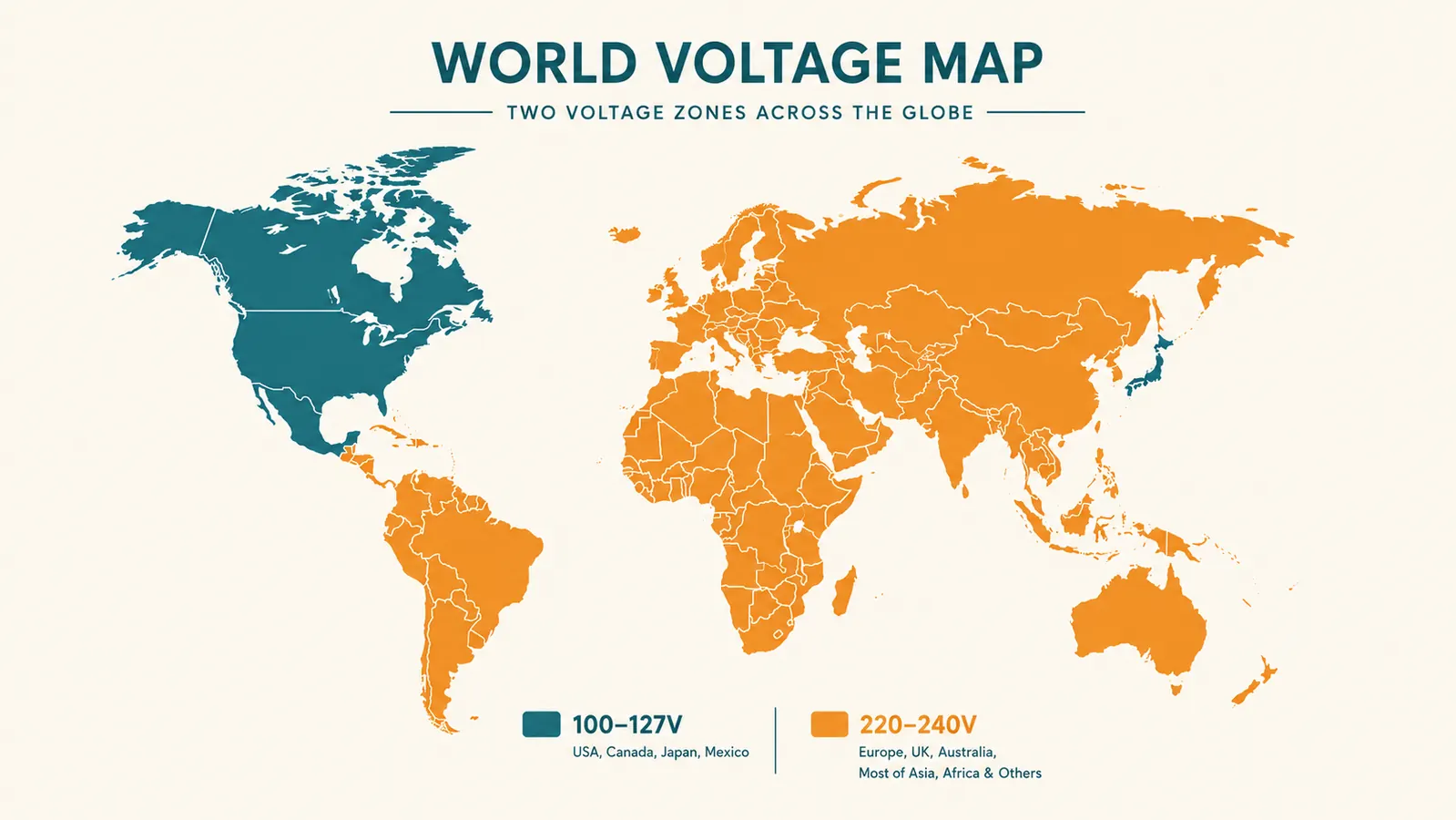
The key to this whole decision is printed on a tiny label stuck to your device or its power brick. Look for a line that reads something like INPUT: 100-240V, 50-60Hz. If you see that range, your device is dual voltage. It is engineered to run on any electrical system in the world, from Japan's 100V grid to Europe's 230V standard. All a dual-voltage device needs is the right plug shape to fit the local outlet. That is exactly what a travel adapter provides.
If the label reads INPUT: 110V or INPUT: 120V with no range, your device is single voltage. It was built for the North American grid. Plug it directly into a 220V European outlet and you will get a very loud pop, possibly a small fire, and definitely a ruined appliance. That is the narrow use case where a voltage converter earns its keep. The converter steps the voltage down before it reaches your device, so the device never sees more than it can handle.
Here is the practical reality: virtually every laptop, smartphone charger, camera battery charger, e-reader, and USB power brick made in the last ten years is dual voltage. Manufacturers build for a global market. The devices that commonly trip people up are older or high-wattage hair tools, some flat irons, older electric shavers, and certain kitchen appliances that people inexplicably try to bring on international trips. Check the label. If it says 100-240V, buy the VYLEE and skip the converter entirely.
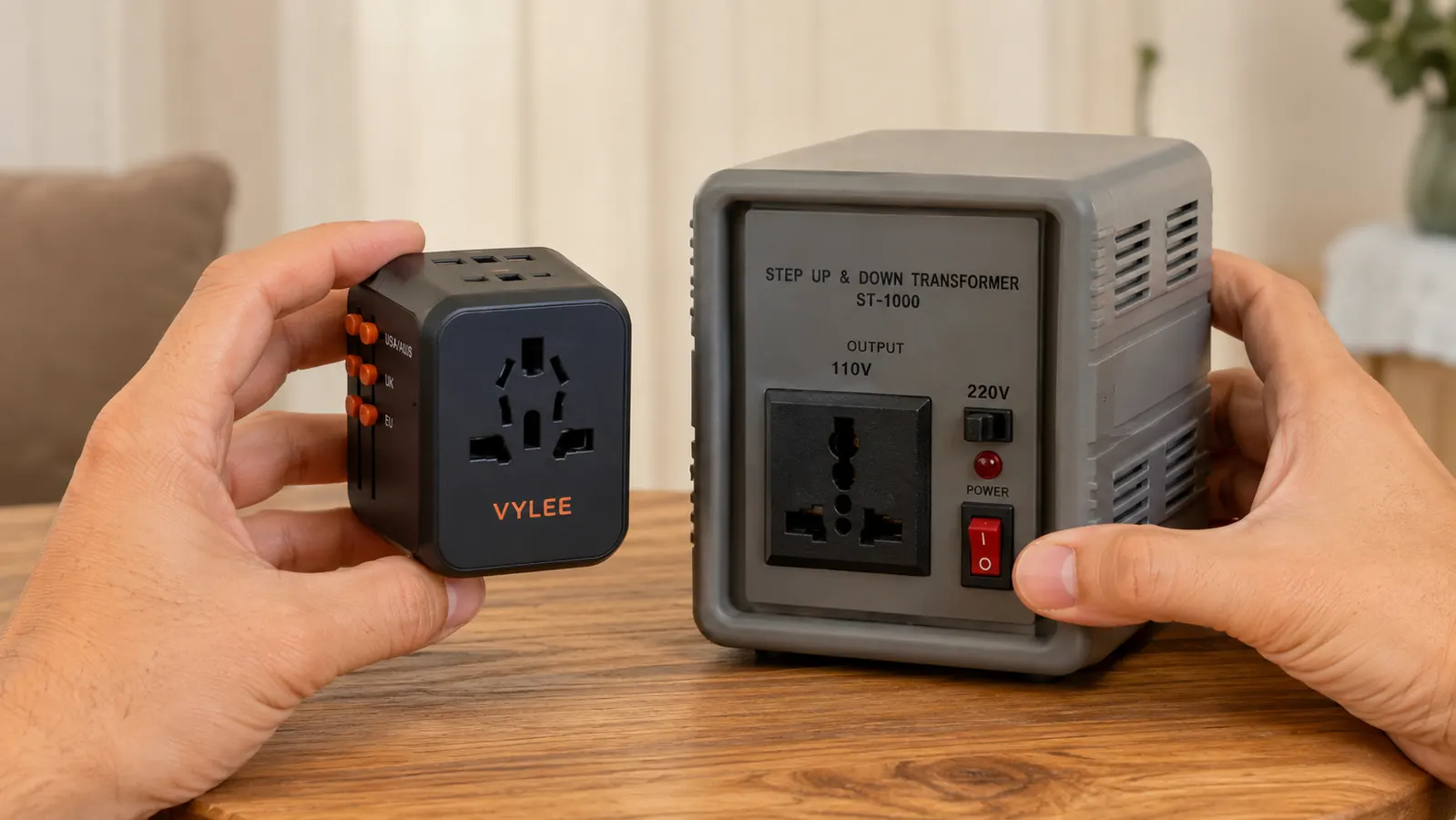
Where the VYLEE Travel Adapter Wins
The VYLEE 5-in-1 covers the four most common international plug types in one compact unit: Type A/B for the Americas and Japan, Type C/E/F for continental Europe and most of Asia, Type G for the UK, Ireland, Hong Kong, and parts of Africa, and Type I for Australia and New Zealand. That combination covers more than 150 countries. You carry one small device and you are set for virtually any destination without thinking about it again. I have used this across five countries in a single trip without once wondering whether I had the right configuration.
The built-in USB charging is where the VYLEE separates itself from a bare plug adapter. Two USB-A ports and two USB-C ports mean you can charge your phone, your partner's phone, your earbuds, and your Kindle all from one outlet while your laptop plugs into the adapter's main socket. In a hotel room with one outlet near the bed, that is not a convenience, it is a necessity. A voltage converter gives you none of that. You would still need a separate USB charger and a power strip, and your bag gets heavier and messier fast.
Where a Voltage Converter Wins
A voltage converter wins in exactly one situation: you have a single-voltage appliance that you are not willing to replace or rent at your destination. The most common real-world example is a professional-grade hair dryer or styling tool that is rated 110V only. Travel-specific versions of these tools exist and are dual voltage, but a lot of people own salon-quality tools that are not. If you are a stylist traveling internationally for work and your specific tool does not come in a travel version, a converter is the right call.
The catch is that converters are rated by wattage, and you have to match or exceed your appliance's draw. A 1,500-watt hair dryer needs at least a 1,500-watt converter, and quality units at that rating are heavy and bulky. You are looking at close to a pound of extra gear minimum, usually more. For carry-on-only travelers, that is often a dealbreaker. Many people in this situation find it easier to buy a dual-voltage travel hair dryer once and never think about converters again.
Check your device's label for 100-240V. If you see that range, a travel adapter is all you need. A voltage converter solves a problem most modern travelers no longer have.
Most travelers need an adapter, not a converter. This is the one I use.
The VYLEE 5-in-1 universal travel adapter covers 150+ countries, charges 4 devices at once via built-in USB-A and USB-C ports, and weighs about as much as a granola bar. It has 4.6 stars across 14,000+ reviews and costs less than a meal at the airport.
Amazon Check Today's Price on Amazon →The Most Common Mistake: Assuming an Adapter Converts Voltage
This is the mistake that costs people money and, occasionally, safety. A travel adapter is purely mechanical. It reshapes the physical plug pins so they fit into a different style of outlet. It does not touch the electricity itself. The voltage coming out of a UK Type G outlet is still 230V whether you plug a VYLEE adapter into it or not. If your device needs 110V and you connect it through an adapter into a 230V outlet, the adapter does nothing to protect it. You still get 230V and the device still fails.
The good news is that this only matters for single-voltage devices, and most modern electronics are not single-voltage. The confusion comes from the fact that adapters and converters look somewhat similar to people who have never thought about them. They are both small boxes that sit between your plug and the wall. The function is completely different. One changes shape. The other changes voltage. Knowing which problem you have tells you exactly which tool to buy.
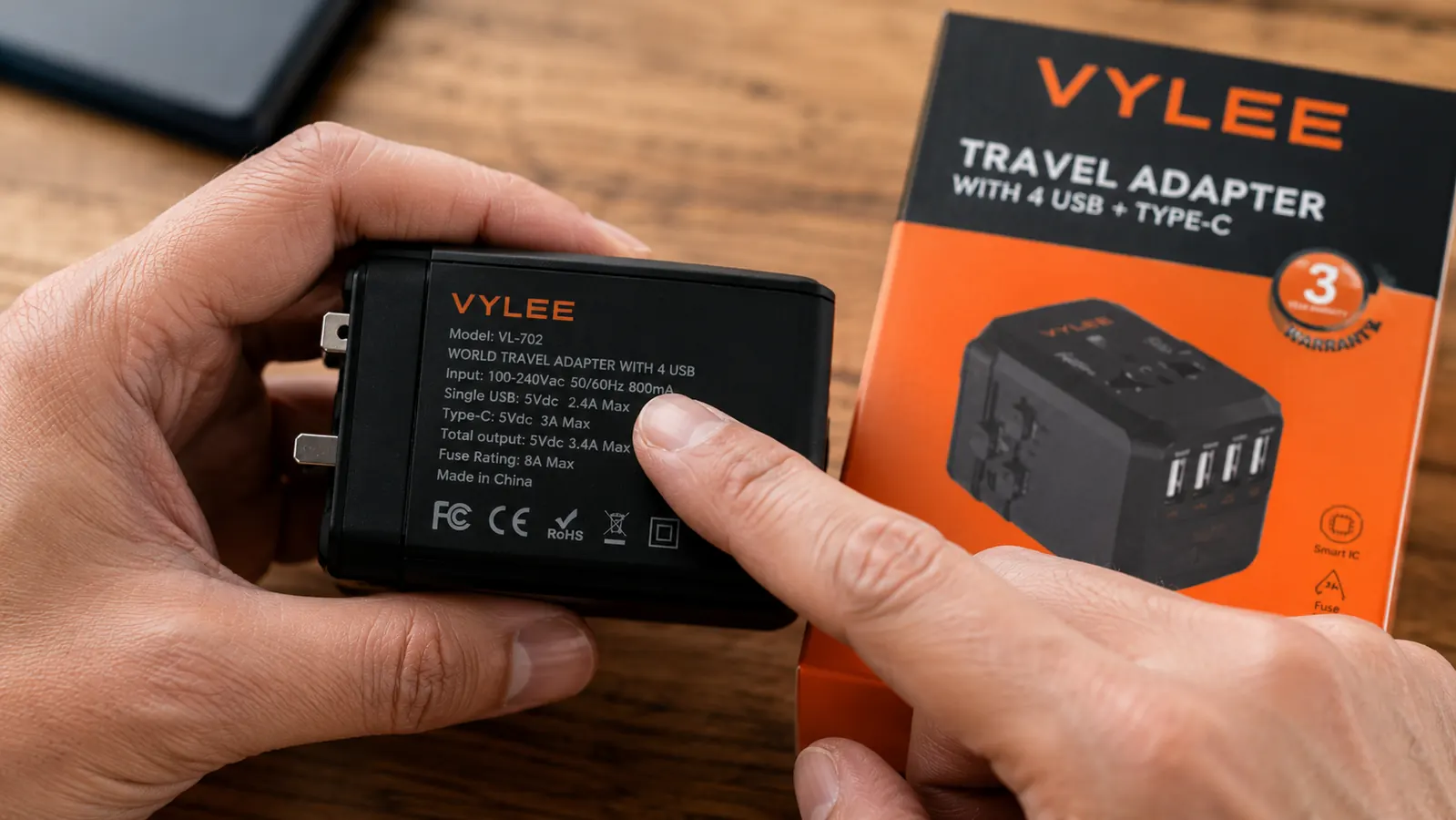
Quick Diagnostic: Do You Need an Adapter or a Converter?
Work through this in under a minute. Pick up every device you plan to charge or power abroad. Find the label on the device itself or on its charging brick. If every label shows 100-240V input, stop here. You need only a travel adapter. If any label shows a single voltage (110V, 120V, or similar), you have two options: replace that device with a dual-voltage version before your trip, or bring a wattage-appropriate voltage converter for that specific appliance and a travel adapter for everything else. Most people, after doing this exercise, discover they need nothing but the adapter.
A few items that are almost always dual voltage these days: MacBook and Windows laptop chargers, iPhone and Android USB-C chargers, GoPro battery chargers, Kindle and iPad chargers, Sony and Canon camera chargers, electric toothbrush chargers (though check the base, not just the brush head), and noise-canceling headphone chargers. Items that are often single voltage and worth checking carefully: older US hair dryers, flat irons without a clearly stated dual-voltage mode, some electric shavers from more than five years ago, and any countertop kitchen appliance.
Who Should Buy Which
Buy the VYLEE travel adapter if you travel internationally with a phone, laptop, tablet, camera, earbuds, or any combination of the above. That covers the vast majority of leisure travelers, business travelers, remote workers, and backpackers. At a budget price, it is one of the few travel accessories where the price-to-usefulness ratio is almost absurd. The built-in USB charging alone is worth the cost compared to carrying a separate travel power strip. See the full hands-on review for a deeper look at the VYLEE's performance across specific countries and outlet types: VYLEE Universal Travel Adapter Review.
Buy a voltage converter if you have confirmed, by checking the label, that you own a single-voltage appliance you cannot replace or rent at your destination, and that appliance is important enough to justify the added weight and bulk. This is a genuine minority of travelers. Even within that group, many find that buying a dual-voltage version of the same appliance before the trip costs less than a quality converter and solves the problem permanently. If you decide you do need to power multiple devices abroad from a single unit, the guide to charging all your devices abroad with one adapter walks through how to set up your kit efficiently: How to Charge Every Device You Own Abroad Using One Universal Travel Adapter.
Ready to pack the adapter and skip the converter? Start here.
The VYLEE 5-in-1 covers 150+ countries, includes four USB charging ports, and fits in the palm of your hand. If your devices show 100-240V on the label, this is the only charging accessory you need for international travel.
Amazon Check Today's Price on Amazon →